
Magnitsky Awards
Alexei and Maria Moskalev (Russia)
COURAGE UNDER FIRE
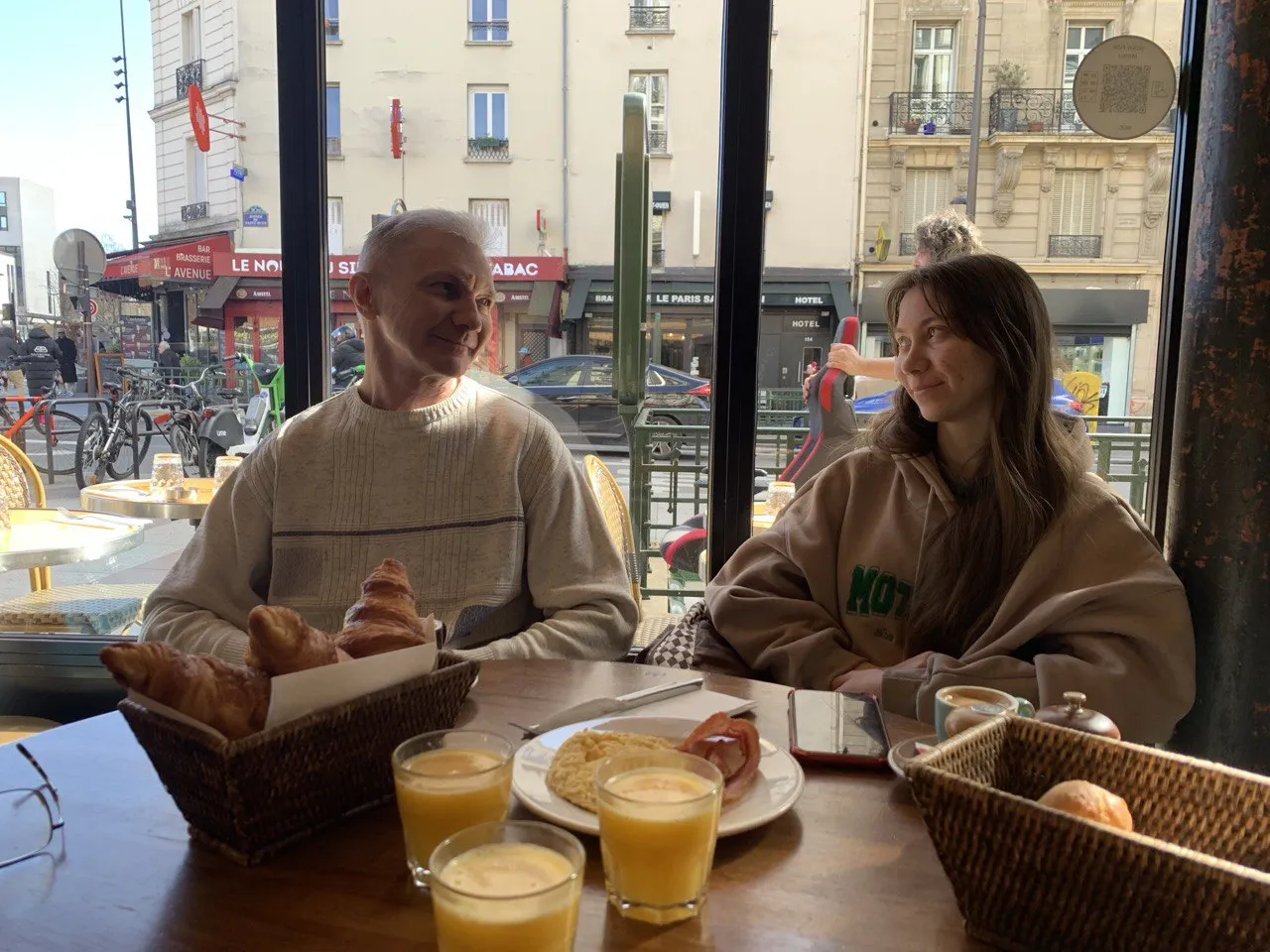
Award Winner 2026
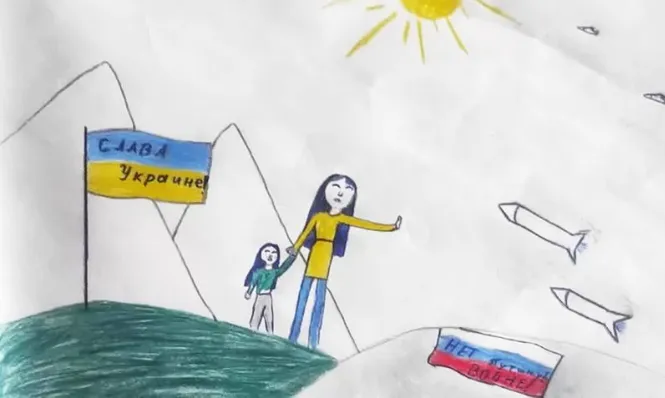
Alexei Moskalev is a Russian entrepreneur and former political prisoner whose persecution began after his 12-year-old daughter, Maria (Masha), drew an anti-war picture at school in 2022, depicting Russian missiles flying towards a Ukrainian mother and child.
Having raised Maria as a single father since she was three, Alexei taught her the importance of honesty, compassion and standing up for what is right. Her drawing, created in response to a school assignment supporting Russia’s invasion of Ukraine, triggered a campaign of intimidation and persecution by the Russian authorities.
Alexei was repeatedly interrogated, subjected to police raids and eventually imprisoned, while Maria was forcibly separated from him and placed in a children’s institution. Their case attracted international attention and became a powerful symbol of Russia’s repression of anti-war dissent.
Following his release from prison on 15 October 2024, Alexei was reunited with Maria. Fearing further persecution, they fled Russia for Armenia before receiving protection from France, where they arrived in March 2026.
Today, Alexei and Maria live in Paris. Maria continues to express her opposition to the war through art, writing and social media, while their story stands as a testament to the courage of those who refuse to remain silent in the face of injustice.
Anti-war cartoon by 12 Y old Masha M
Alexei Moskalev: My Story and My Daughter Maria’s Courage
My name is Alexei Moskalev. I am an entrepreneur and a former political prisoner from Russia.
I have raised my daughter Maria, whom I affectionately call Masha, on my own since she was three years old. At the age of three and a half, she began attending preparatory classes for primary school, and at six and a half, she started school.
She has always been a kind, caring and compassionate child, with a particular love for animals. Sometimes she would bring home stray kittens, and together we would build little shelters outside to protect them from bad weather.
I also had a small private zoo, where I kept a variety of ornamental birds and animals, including Indian peacocks, different breeds of pheasants, American turkeys, wild ducks, pedigree geese, African guinea fowl, twelve breeds of ornamental chickens, and decorative rabbits. Masha helped me look after all these animals and shared my joy whenever new babies were born.
In 2022, when Putin’s Russia launched its brutal invasion of neighbouring Ukraine under the pretext of what it called a “special military operation”, Masha was deeply affected by what was happening. She often asked me to show her and explain the horrors unfolding in the Ukrainian territories occupied by Russia.
I had always tried to raise my daughter to be honest, courageous and unafraid to speak her mind, never to be hypocritical or to fall victim to the lies and propaganda constantly broadcast by the Russian state media.
I showed her video footage that my friends in Ukraine had sent me through social media. This included evidence of crimes committed by Russian forces in Bucha and other parts of Ukraine: looting, violence, atrocities and the killing of innocent civilians who had remained in the occupied territories. She also saw images of children who had lost arms or legs in Russian bombardments of civilian areas and were now living with prosthetic limbs.
Masha took all of this very much to heart.
When Masha was twelve years old and in the sixth grade, her art teacher asked the class to produce drawings in support of the so-called “special military operation”, the Russian armed forces, President Putin and Russia.
Masha was the only pupil in her class who chose to draw something entirely different.
She produced what later became her famous anti-war drawing. It depicted the Russian and Ukrainian flags, a woman and a child standing between them, and missiles flying from the Russian side towards Ukraine.
I first saw this drawing when I came to collect Masha from school at the end of the day.
The school headmistress spotted me in the entrance hall and called the police. Within literally five minutes, four police officers arrived.
They showed me my daughter’s drawing and asked:
“Do you know what your daughter has been doing?”
After looking at the drawing, my first question was what could possibly be criminal about a child’s artwork expressing her own views and understanding of what was happening.
The police replied:
“Surely you understand that we are currently conducting a special military operation in Ukraine?”
I responded firmly:
“It is you who started this war and are waging it. My daughter and I have nothing against the Ukrainian people or Ukraine as a country.”
Following this exchange, the police drew up several official reports against us and escorted us to the police station, where we were detained for three and a half hours. We were then taken to court, where my daughter and I were forced to spend another three and a half hours sitting in a corridor under police guard.
Naturally, Masha was deeply frightened by everything she had experienced. She begged me not to send her back to school.
I did my best to reassure her, telling her that the court hearing was over and that I hoped the authorities would now leave us alone.
The following morning, I personally accompanied her to school.
At 9:30 a.m., I received a telephone call from Masha’s class teacher, telling me that I needed to come immediately because officers from the Federal Security Service (FSB) had taken my daughter directly out of her classroom.
This happened on 26 April 2022.
I immediately got dressed and rushed to the FSB building. At the entrance, I was searched, my documents and personal belongings were confiscated, and I was taken into an office.
Masha was not there.
My first question was:
“Where is my daughter?”
An FSB officer replied that she was in the next room, where officers were “having a conversation” with her.
I was interrogated for more than three hours. They questioned me about my attitude towards the so-called special military operation, towards Putin personally, and towards the Russian armed forces.
After the interrogation, my daughter and I were released.
We were left alone until 30 December 2022.
On that morning, at 6:30 a.m., while Masha was still fast asleep, a group of twelve FSB officers and police officers burst into our apartment to conduct a search.
They forced me face down onto the floor and pressed their feet against my back and head.
Masha witnessed everything. She was in complete shock and cried uncontrollably.
The officers turned the entire apartment upside down, searching through our furniture and personal belongings.
Afterwards, we were both taken to the FSB headquarters. Masha was placed in a temporary rehabilitation centre for children, while I was subjected to psychological and physical pressure.
Around lunchtime, an ambulance had to be called because I began experiencing heart problems.
The interrogation lasted thirteen hours.
During breaks, the officers would turn up the Russian national anthem to full volume and leave the room, while I remained handcuffed.
At nine o’clock that evening, I was finally released under a written undertaking not to leave the area. Of all the documents confiscated during the search, only my passport was returned.
The following day, I personally went to the children’s centre where Masha was being held and brought her home.
After these events, we were forced to leave our hometown. We gave away all our beloved animals and birds free of charge, leaving behind the life we had built together.
We moved to another location, but our peace lasted only about two months.
The authorities eventually tracked us down and detained us again.
Masha was immediately placed in a temporary children’s shelter, while I was transported back to our hometown, taken to the Investigative Committee and subsequently placed in a detention facility.
Several days later, following the intervention of my lawyer, my detention was replaced with house arrest.
Throughout this period, my daughter was kept in complete isolation.
My lawyer was not allowed to visit her. Neither were journalists, volunteers or representatives of human rights organisations. Parcels were not delivered to her, and she was denied the opportunity to make telephone calls.
The only exception was a call with her mother, and even that conversation took place under the close supervision of the institution’s director.
While I was in detention, my greatest concern was not my own fate but that of my daughter.
I constantly worried about her health, how she was coping, and what kind of psychological pressure and intimidation she might be facing.
Yet Masha proved to be an extraordinarily strong and courageous girl.
It was while I was in prison, serving a two-year sentence imposed by Putin’s court, that I learned that, following enormous pressure and persistent persuasion, Masha’s mother had eventually taken her into her new family.
I was finally released from prison on 15 October 2024.
Masha and I were reunited at last.
It was the happiest day of my life.
When we returned home, however, our relief was short-lived.
The very next day, a neighbour told us that police officers had come looking for us again. They had banged on the door, repeatedly rung the bell, and spent a long time walking around the house trying to find us.
It became clear that the authorities had no intention of leaving us in peace.
We therefore made the difficult decision to leave Russia altogether.
On 24 October 2024, we left Russia for Armenia, where we lived for one year and four months.
During our time in Armenia, Masha devoted herself seriously to art. She began drawing portraits of well-known public figures and political prisoners, as well as writing stories.
Unfortunately, Germany never responded to our application for asylum, as the relevant programme had been suspended.
After we submitted a further request to France, the French authorities responded quickly and offered us the opportunity to come to the country and receive protection.
On 11 March 2026, my daughter and I finally arrived in Paris, where we are living today.
Even in a new country, Masha refuses to remain on the sidelines.
She is increasingly interested in politics and determined to make her voice heard. She runs her own YouTube channel and is active on social media, including Facebook, Telegram and Instagram, where she openly expresses her political views and stands up for what she believes in.
Throughout everything we have endured, Masha has remained true to the values I tried to teach her from childhood: honesty, compassion, courage and the determination to speak the truth, even when doing so comes at a terrible personal cost.